
When Will You Find a Moment for Yourself?

Editor’s Note: This is a contribution by Pamela Jorrrick

“Sometimes the most important thing in a whole day is the rest we take between two deep breaths.” ~Etty Hillesum

For the second time in a week, the gas light comes on in my car. I’m busy, as usual, and so I push it a little farther, run just a few more errands. But I know that I do need to stop and refill before too long, or I will be left on the side of the road. I’ve been stranded before, and have learned my lesson.

Most of us know that when our cars try to tell us they need something, we had better respond or they won’t get us to our destinations.

We usually have some respect for red warning lights on the dashboard, and at least check out the problem. Unfortunately, it’s not always so easy to see our own signals.

Our bodies and minds don’t come with bright red warning lights, but they do give us signals when they’re running low.

Some of these signals are more obvious than others. When we’re hungry, we might be able to skip a meal occasionally, relying on snacks to get us by, but we all know that at some point, we need to eat real food.

We might be able to miss a few hours of sleep as well, and make it through the next day, but we can’t simply expect our bodies to keep performing without rest.

We may be able to survive in a grumpier and lesser performing fashion when we have less than optimal amounts of food and sleep, but we all know that we can’t skip those needs altogether.

But, what about the other needs that aren’t so obvious? Everyone has probably heard about the benefits of spending some time alone just to think and to gather their own thoughts.

If you work, go to school, have a roommate, spouse or children, this time probably isn’t easy to come by. It’s probably also more important than ever.

Lately, I’ve noticed just how important this need for solitude is to me. As a writer who works at home, as well as a homeschooling mother, I am blessed with lots of time with my family. What I’m lacking severely is time to myself.

Between errands, online college classes, a part-time job, volunteering, and meeting the needs of everyone else, I often end up neglecting my own need for a moment to myself to think, breathe, read, write, draw, paint, or do anything that helps me relax. Click Here to Read More…

Please Share the Wisdom :)

Tiny Buddha Book Giveaway and Top 10 Insights of 2011

Tiny Buddha Chilling on a Cairn

by Lori Deschene

Important Note: The winners for this giveaway have already been chosen! You can purchase Tiny Buddha: Simple Wisdom for Life’s Hard Questions on Amazon.com. Also, be sure to subscribe to Tiny Buddha for free daily or weekly emails!

The winners:

Happy almost 2012!

It’s been an exciting year for Tiny Buddha. For one thing, the community has grown, but what I find most exciting is that the number of people sharing their stories and engaging with other people has increased exponentially.

During the first year, I published two posts from the community per week. In January of 2011, submissions slowed down, and I wondered if perhaps I’d need to take a new direction with the blog.

In February, however that all changed, and posts started coming in so frequently that I was able to publish one per day, and oftentimes had to ask people to hold off on submitting so that I could catch up.

That has remained steady all year, and I’m excited to see that countless insightful, helpful, loving conversations have unfolded in the comments, some which included me and others that did not.

Tiny Buddha is what it is because people are willing to be honest about their experiences, and in doing so help others and let them know they are not alone. If you haven’t already, I hope you’ll contribute a post in 2012!

I have learned so much for everyone who has shared themselves here. So here are the top 10 insights of 2011 (based on page views and comments): Click Here to Read More…

Please Share the Wisdom :)

Battling with Your Body: 4 Simple Tips for Overall Well-Being

Editor’s Note: This is a contribution by Jennifer Marsh

“Your body is precious. It is our vehicle for awakening. Treat it with care.” ~Buddha

I believe there are four key aspects to our existence:  mental, physical, spiritual and emotional.  The mind is a fairly straightforward concept, and many people can identify with a spiritual component of life.

Yet there is one other aspect of life that I believe is essential to a full and healthy journey on this planet—the emotional element of living. And that emotional state seems to be inextricably tied to the physical.

I have always struggled with the physical. I’ve had a love-hate relationship with my body since I was cognizant of my existence. As a chubby kid, I felt different and defective. I sought relief in my grandmother’s frozen cool whip in the extra freezer located in our garage.

I gulped down chalky pink Pepto-Bismol when I wasn’t even sick. Why? Because it was sweet.

I couldn’t handle the monkey bars. The ball always hit me in the face. I was always last to finish running around the field at recess.  As I matured, I grew out of the chubbiness but I was never satisfied with my body.

I spent the summer of my 11th year frantically emulating a 1984-era Richard Simmons in his 7-Minute Abs video and simultaneously saving enough money to buy a McChicken sandwich, fries, and a hot fudge sundae at McDonalds.

Disconnected from my body, I grew into a young woman and ignored my physical existence as best I could; becoming what author Geneen Roth calls a “walking head” with that insufferable body attached. 

I alternated between trying to eat “right,” permitting myself to eat “bad,” and feeling bad about eating bad.  If I ate a salad for lunch, I might have a half-gallon of ice cream for dinner. Alcohol eventually contributed to my lack of self-care, adding extra calories and acting as yet another way to escape my body.

Fast forward through my twenties: After several attempts at Weight Watchers, a failed relationship, a bout with antidepressants, and a nervous breakdown, I managed to lose over 40 pounds with Weight Watchers. Down to the size I wore when I graduated from high school, I was sure my life would get better.

It didn’t. It got worse. So I dyed my hair blond. I drank more wine.

Then I stopped drinking. I stopped smoking cigarettes. I fully embraced sobriety, found a higher power, and earned two master’s degrees. I lost even more weight. Now my life should be perfect, right? 

Wrong. I still can’t live comfortably in my body. And I’m soothing my discontented soul and body with food. Now it’s ice cream (or more specifically, Ben and Jerry’s Half Baked Frozen Yogurt, which has only 3 grams of fat per serving, compared to Peanut Butter Cup ice cream which has 25 grams of fat, so it isn’t that bad).  Click Here to Read More…

Please Share the Wisdom :)

Balanced Living: How to Stay on Track

Editor’s Note: This is a contribution by Amanda Snow

“Continuous effort—not strength or intelligence—is the key to unlocking our potential.” ~Winston Churchill

I declared myself a mess a long time ago. I lived in a constant, dull state of fear and anxiety. My emotions were more volatile than hurricane season, and not even I could predict how any given situation would affect me.

I may not have known it at the time, but I was miserable. I was trying to be someone I wasn’t and fit into a fast-paced life that I just wasn’t made for.

I was constantly overwhelmed by just about everything—being stuck in traffic, waiting in lines, driving long distances, folding the laundry, working a full day, even doing my hair.

It seemed like life was a struggle and a whole lot of effort that didn’t really get me anywhere.

Apparently overtime, I had conditioned myself to react to the activity and obligations of my life with worry, anxiety, and exponential stress.

I didn’t crave the life I was living. I craved balance. And I lacked passion. Something had to give.

It did, almost by mistake. I found myself poking around Tiny Buddha about a year ago, and the rest was history. Over time I discovered newfound energy by changing my internal perspective on daily living.

I challenged my toxic thoughts and actions and found peace in the present moment.  I uncovered new ways to look at emotions, relationships, and situations in my life.

Instead of continuing to fight it, I made a decision to accept and flow with the monotony, bustle, and pressure of life. I made a list of what was truly important to me instead of living by someone else’s rules. Also, I stopped sabotaging my body with distorted eating habits.

I realized that I was okay, that I was enough, and it was actually pretty cool to be me.

As a result, I feel more settled. I also feel more direction and balance than ever before in my life. I still get wound up, but my lows are nowhere near as low as before. Click Here to Read More…

Please Share the Wisdom :)

How to Set Healthy Boundaries: 3 Crucial First Steps

 Editor’s Note: This is a contribution by Britt Bolnick

“You change for two reasons: Either you learn enough that you want to, or you’ve been hurt enough that you have to.” ~Unknown

I learned about boundary work when I was teaching in the NYC jails with male prisoners.

After driving onto a maximum security island of electric, clanging gates, I encountered metal detectors, hallways filled with yelling, chaotic inmates, and tension and anxiety in the air that was almost tangible.

I started my work day tensed up and ended it drained, exhausted, and overwhelmed.

In other areas of my life, the same thing was happening. In my personal relationships, I couldn’t find the edges where I ended and others began. I sometimes felt powerless, unsure of who I was in relationships, and unheard. I wasn’t sure how to change my life, but I knew that I had to.

Because I didn’t set healthy personal boundaries, I was exhausted, I couldn’t focus, and I felt consumed by drama around me, in both my personal and professional lives. As I result, I dealt with a lot of conflict, failed to take care of myself, and generally disliked my work.

Since I knew I loved my work, I took some time to reflect on why my job wasn’t working for me. I then decided to try some experimenting.

I started doing a little boundary and grounding work each morning before I even entered each facility. At the end of each day, before I went home to my baby, I did a short releasing meditation in my car. Click Here to Read More…

Please Share the Wisdom :)

13 Tips for Eating More Compassionately

Editor’s Note: This is a contribution by Jules Clancy

“If you want others to be happy, practice compassion. If you want to be happy, practice compassion.” ~Dalai Lama

As a child, I had no idea that such a concept as vegetarianism even existed, let alone veganism.

Since I grew up on a sheep farm, raising animals and eating them were just what we did.

The sheep, cows, and chickens from my childhood seemed to have pretty happy lives. There was grass to eat and water to drink and space to roam about. The only thing that used to worry me about them was that they’d freeze outside in the winter with no coats on.

It wasn’t until I went to university that I even thought to question whether I should be eating lamb, or beef, or chicken.

Over the years, I’ve come back to the point of view that while I really respect people who choose to be completely vegetarian or vegan, it’s not for me.

As a little experiment, I spent a month being vegetarian last year. While I found I struggled with a completely plant based diet, it did give me some great ideas for how to eat more compassionately by not eating meat every day.

It was quite refreshing to look at my diet with a completely fresh pair of eyes. To be honest, I was surprised how easy was to adapt some of my favorite dishes to suit a meat-free way of eating.

Here are some of the lessons I’ve picked up to help get you started eating more compassionately. Click Here to Read More…

Please Share the Wisdom :)

Beat Procrastination: How to Want to Tackle Your To-Do List

Editor’s Note: This is a contribution by Kathryn Britt

“Until you value yourself, you won’t value your time. Until you value your time, you won’t do anything with it.” ~ M. Scott Peck

Ten years ago, I stopped procrastinating. Lots of procrastination, then zero—overnight. Cold turkey worked for me. Now I hardly ever procrastinate.

Why the sudden change? How did I do it?

Lists and Procrastination

Like many people, I make lists, including to-do lists, reminders, shopping lists, wish lists, and my what-to-do-when-bored list. I completely rely on my lists to keep my life moving along.

My Dad purposefully decided not to make lists. He believed he could maintain his memory better if he didn’t rely on them. Could be true, because he always had a good memory.

Not me, however. I do seem to need lists to remind me about important to-do things. When I write something on a to-do list, I can get it off my mind for now, knowing I’ll have that reminder. So why not just do that important thing now instead of writing it down? Well, sometimes that’s not practical or possible.

But sometimes it is. Sometimes writing a to-do item on a list can actually be an act of procrastination.

Apparently lists and procrastination go hand in hand for some of us. My reason for making lists is to ensure that things get done, yet writing something on a list can also make it easier for me to procrastinate doing it. Once the to-do item is on a list, it’s off my mind—so it might never get done.

There’s something wrong with that picture. Making lists to remember to do things, and then avoiding those lists because of a procrastination problem? A deadly combo in terms of productivity! Click Here to Read More…

Please Share the Wisdom :)

How to Change Your Mind and Your Life by Using Affirmations

Editor’s Note: This is a contribution by Kathryn Britt

“All that we are is the result of what we have thought. The mind is everything. What we think we become.” ~Buddha

I used to teach Adult Upgrading. My students were people who had never completed grade school and/or high school. For a variety of reasons, they were now ready to try it again.

New students would say, “I wasn’t ever any good at school.” “I can’t do math.” “I hate fractions.”

It’s my belief that our self-talk is programming ourselves for our statements to be true.

Those students thought they’d been stating the facts, not revealing programmed beliefs.

My work was less about teaching math than it was about coaching them toward a change in their beliefs about themselves.

“I never again want to hear you say you’re not good at math,” I’d say. I’d ask them to switch to “I’m learning math” or “I’m getting better at math” or “I’m working on fractions.”

I’d help them start to notice their own negative self-talk and then transform it into positive statements. “Sure it sounds weird. So humor me,” I’d have to say. “Yes, I know it doesn’t feel like it’s true. Not yet, anyway.” They’d roll their eyes at me.

I’ve read that schools teach fractions before many of our brains are developmentally ready to cope at that conceptual level. I believe this, because I’ve met so many people whose problems in school began around the time fractions were introduced.

Children’s developing self-images are vulnerable. Once children begin to feel stupid about a school subject, the negative self-talk begins. It soon defeats their egos along with their will to learn. Click Here to Read More…

Please Share the Wisdom :)

How to Enjoy Food More: 7 Tips to Savor Meals

by Lori Deschene

“We are indeed much more than what we eat, but what we eat can nevertheless help us to be much more than what we are.” –Adelle Davis

As I mentioned before in my blog post about needing less money, I recently decided to offer barter advertising through Tiny Buddha—meaning I plan to promote products and services I support in exchange for things I need.

This week I started my first barter arrangement with L.O.V.E. Delivery, a company here in Los Angeles that delivers organic produce right to your door.

Before my first shipment arrived two days ago, I actually found myself anticipating its arrival with giddy enthusiasm, like a kid on Christmas.

It was kind of exciting to know I’d be getting a more diverse assortment of produce than I’d purchase in the store; and it would all be naturally produced, fresh, and personally packaged by someone who loves the work he does.

I also appreciated that receiving this food created a sense of mealtime mindfulness that started with the delivery, extended to the preparation, and then culminated with a sense of hyper-awareness while eating. It’s instinctive to savor food when you feel a sense of respect and even awe for it.

I haven’t always felt that way. As a teen and in my early 20s, food was my enemy. I felt happiest when I felt in control of it—meaning I ate a minimal amount of it.

Even after I adopted a healthier attitude toward food, it remained a rival of sorts. All too often, I hurried through the grocery store, piled the cheapest and easiest-to-prepare items in my cart, and then rushed through the acts of cooking and eating, like items to be checked off my to-do list.

Anyone who has traveled internationally knows that many other cultures enjoy the experience of preparing and eating meals far more than most of us do in the United States. Click Here to Read More…

Please Share the Wisdom :)

The (Real) Secret to Staying Young

Editor’s Note: This is a contribution by Anél Hamersma

“When you’re finished changing, you’re finished.” ~Benjamin Franklin

You know them well.

They pop out of every magazine you open and every billboard you drive by: skinny sixteen year-old models with blemish- and wrinkle-free skin staring blankly back at you. Like they own the place or something.

If you don’t have their complexion and shape you probably wince the same way I do when you see them splattered on that advertising campaign. Youth is where it’s at in the twenty first century.  We’re told it’s desirable and that we should want it—and inevitably, many of us do.

On any given weekday you will find perfectly sane women trampling each other to get to wildly over-priced beauty-products (read: the same ones advertised on that billboard you drove by earlier) at our handy local beauty store.

Then we head on over to the gym where we run, lift weights, and cycle ourselves till within an inch of our lives before jetting off home to soak our faces in that New!Magic!Serum! (read: fetuses liquidized with rat tails and just a dash of pigs foot and perfume to cover it all up).

And rinse and repeat.

Inevitably, one sunny morning just before your (please insert) birthday, you look into the mirror and see a line cracking down like the crater of doom from the corner of your eye towards your slightly saggy cheek.

Don’t hyperventilate.  I’m here to deliver the good news:

You don’t really want to be young again!

You might as well wish you were Santa Claus or Oprah. It’s never going to happen. Besides, you had to sit through puberty and all that to get where you are now, and I’m guessing you’re probably quite happy to be here.

You might enjoy the notion of being youthful instead, because that’s a completely different thing, you see. In fact, that’s something you can actually achieve. Click Here to Read More…

Please Share the Wisdom :)

What It Means to Really Take Care of Yourself

Editor’s Note: This is a contribution by Cat Li Stevenson

“Be gentle with yourself. You are a child of the universe, no less than the trees and the stars. In the noisy confusion of life, keep peace in your soul.” ~Max Ehrmann

Last year, I realized that I lived 28 years without knowing what it really means to love and take care of myself.

In 2010, I took some wonderful, worldly trips—Costa Rica, Bangkok, Taipei—trekking and exploring.

My husband and I bought a second home. I fully engaged myself in the improvements, and the creativity of decorating a fresh canvas.

I ran several races, including a half-marathon, and finished well. I joined a swanky health and fitness club where I could take trendy aerobic classes. I was “taking good care of myself.”

Life was good. I worked hard, I played hard. The end. That was the story I projected.

But it was hardly that simple or fabulous.

There was a whole lot of turbulence in my life that I was trying to fix externally: Click Here to Read More…

Please Share the Wisdom :)

The Secret to (High) Self-Esteem

Editor’s Note: This is a contribution by Susie

“Concern yourself not with what is right and what is wrong but with what is important.” ~Unknown

I personally do not know anyone who, after all is said and done, is not after high self-esteem.

It may not be blatant or obvious to the eye, yet once you break down the motives and emotions surrounding the things people choose to do and why they choose to do them, you will find that what they really want is to feel good about themselves.

They want to have high self-esteem. So the big question is: How do we raise our self-esteem and keep it at a high level?

I know for me it has been and is still is a daily and almost constant battle to keep my self-esteem at a normal to high level. Some days I do better than others. What has changed over the past year or so is that I have realized what it is that triggers my self-esteem ups and downs.

What Is Self-Esteem?

According to the Merriam-Webster online dictionary, self-esteem is a confidence and satisfaction in oneself or self respect. So how do we gain confidence and satisfaction in ourselves? Why is it that some people have higher self-esteem and some have lower self-esteem?

Why do some successful people have low self-esteem while at times people who have failed have a high level of self-esteem? Is it something that we gain from external sources such as praise or is it something internal?

Here is what I’ve discovered: Click Here to Read More…

Please Share the Wisdom :)

Zen Your Commute: 6 Tips to Start Bicycling and Enjoy the Ride

Editor’s Note: This is a contribution by Tory Syracuse

“I cannot make my days longer so I strive to make them better.” ~Henry David Thoreau

Every weekday morning, I set off from my back gate on my bicycle, pushing away from the safe shore of home and entering the unpredictable current of urban life. Every morning, I look forward to the adventure.

Over the course of the ride to work, I watch the city wake up. I feel the particular nuances of the day’s weather—perhaps humid, with a storm building over the mountains, or maybe a faintly warm breeze crosscuts the morning chill, carrying a hint of spring.

I know as I ride east that the rising sun is slightly higher than it was at this time last week. I smell coffee roasting and last night’s fried food dissipating as I pedal through the commercial district at the edge of the university campus. I see birds and runners and dog-walkers, and people doing yard work before the heat of the day sets in.

By the time I get to work, I’m ready to engage in my day. My bike ride serves as a transition from my habit of early morning solitude to a socially engaging workplace, where I need to be “on” most of the time.

Likewise, the ride home is a chance to release the day’s stress, to create a buffer between my work and personal lives.

Like many people, I struggle to keep work “in its place”: not to continue to obsess about it in my free time, to let it go until the next work day. Driving home so often contributes to stress. But when I arrive home by bike, it’s as if I’ve gradually released my work day with each circular swipe of my pedals.

There are many reasons to commute by bike. Simply put, it’s good for you and good for the planet. Click Here to Read More…

Please Share the Wisdom :)

5 Easy Ways to Get into Yoga this Spring

Editor’s Note: This is a contribution by Mandy Burstein

“Letting go isn’t the end of the world; it’s the beginning of a new life.” ~Unknown

As we welcomed the Spring Equinox on March 20th, with it came a sense of lightness in the air—in our bodies with healthier food options, in our minds as we flirt with the idea of summer on the horizon, and in our spirits as we are able to enjoy later sunsets with loved ones.

Spring also welcomes change and renewal, creating an opportunity to cleanse ourselves of hibernating winter habits and find inspiration in nature as wildflowers bloom all around us.

What better time to introduce (or reintroduce!) yourself to the ancient practice of yoga. Let’s face it: Yoga has stood the test of time, enduring over 5000 years, consistently providing a physical, mental, and spiritual outlet for its practitioners.

Now more than ever, yoga seems the perfect escape from our increasingly complex, technology-driven, distracted modern lives.

Finding peace and contentment in the present moment is one of the most challenging things to do, and yoga provides the tools we need to find that much-desired stillness.

As a yoga instructor, my proudest moment is not when a student who once struggled with Chaturanga perfects a forearm handstand. Well, that is a pretty sweet moment! But, by far, it is watching new students unwrap their first yoga mat. Typically of the drug store, super slippery variety, but still exciting nonetheless!

This moment resonates with me because I know, in that moment, that yoga will be a part of their world (whether in a big or small way) for the rest of their lives.

You see, yoga is a lot like chocolate. If you live your whole life never tasting chocolate, you can lead a perfectly content existence, as there is nothing to miss. But, once you have had that first taste, there really is no turning back.

Sure, you might stray from your cravings as you dabble into non-chocolate permitting diets. But the pleasure induced by that familiar taste always lingers somewhere in the back of your mind, until you finally find your way back home, onto your mat.

In honor of that joy we all receive from unwrapping our very first yoga mat, I compiled a list of five rather simplistic (and fun!) ways to integrate yoga into your life this spring. Click Here to Read More…

Please Share the Wisdom :)

10 Steps to Simplify Your Work Life

by Lori Deschene

“Life is actually really simple, but we insist on making it complicated.” ~Confucius

While I have always piled a lot on my plate professionally, I’ve recently introduced more varied elements. Formerly, I may have devoted a long workweek to freelance writing, but I’m now juggling writing, consulting, speaking, editing my upcoming book, and promoting my recent eBook.

I’ve noticed that the biggest complication to my life isn’t necessarily the full, varied schedule; it’s how I think about that busy schedule.

Sometimes I let my to-do list overwhelm me, carrying the weight of the whole through all of the parts.

So instead of just answering an email, I’m responding, thinking about the blog post I want to write later, worrying about the magazine deadline I might not make, and planning to be more effective so that I can get everything done without having to worry so much.

That’s something I sometimes do.

But on other days, I remind myself that I can’t worry my way out of worrying, and that the most effective use of any moment is to fully do whatever it is I’m doing. The rest will get done later. That, I’m learning, is the most important part of simplifying.

The first step in simplifying anything starts with how we think about it.

Of course there’s a lot more to simplifying work than that (which I realize is ironic given that the subject matter is simplification.) Click Here to Read More…

Please Share the Wisdom :)

Mindful Indulging: Having What You Want Without Guilt

Donuts and Berries

Editor’s Note: This is a contribution by Dr. Sharada Hall

“You only lose what you cling to.” ~Buddha

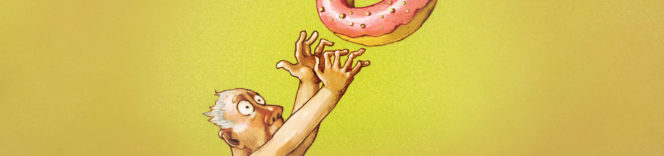
I used to cling to my identity as a person who didn’t eat donuts. To me, donuts represent all that is tempting and yet forbidden. Any self-respecting natural health doctor is not supposed to like donuts, right?

This image I held of myself almost cost me one of the important realizations of my life.

Twenty years ago I was in the midst of my training to become an Ayurvedic health practitioner.  I held tightly and proudly to my dietary restrictions like a fundamentalist’s religion.

This ancient medical system of India dictated that since I was out of balance with too much phlegm, I was to avoid all wheat, dairy, fried foods and sugar. So donuts were definitely a no-no.

On my path to learn Ayurveda, I also began studying the Sanskrit language in which the original medical books were written. I found myself at a Yoga ashram in San Francisco, to attend a Sanskrit class, or so I thought.

What I promptly came face to face with was a 65-year old Indian saint in neon orange robes and dark, wrap-around glasses asking me “Who are you?”

As is traditional in an ashram, after our meditation and Sanskrit lesson, we all gathered around “Guruji” as he blessed the food that had been brought to be passed around and shared. A plate of glazed donut pieces came my way. I politely refused.

Looking back, I can’t even believe I did that. Not to mention I absolutely love glazed donuts. Click Here to Read More…

Please Share the Wisdom :)

Integrating Mind and Body: Be Present, Reduce Stress


Editor’s Note: This is a contribution by Sam Russell

“Don’t let your mind bully your body into believing it must carry the burden of its worries.” ~Astrid Alauda

I don’t believe in the mind/body divide. I can see the gap between them, the one that we put there, but I have little faith in it. In the past month, I’ve learned that in order to live fully, I need to overcome that self-imposed gap.

We all have different mental, emotional, and physical capacities. You could probably run a 5k race, but I’d struggle to even walk it. I know I can work through some of the most difficult decisions, like knowing when to end my pets’ suffering, but you might find that extremely hard to come to terms with.

The thing that we have in common, though, is that we all work at different levels, and whether we choose to believe it or not, our minds and bodies sit together, with each of us.

I took up yoga last month, and I love it. The benefits of getting out for an hour to relax are endless, and I’ve started taking the practice home with me to reap these benefits throughout my week.

I’m headstrong, so I push myself a bit further than I should. Sometimes I go too far and I exhaust myself, or I stretch beyond what my body can manage and end up with extra painful muscles for days.

What’s going on here? It’s that gap between my mind and body. Click Here to Read More…

Please Share the Wisdom :)

6 Tips: Work/Life Balance for People with Big Dreams

by Lori Deschene

“Happiness is not a matter of intensity but of balance, order, rhythm and harmony.” ~Thomas Merton

The vast majority of people I know have two different types of work: the kind that pays the bills, and the kind they wrap their heart around.

For some people, those are one and the same, but often that takes time, dedication, and a willingness to blur the traditional boundaries that separate work and social life.

Because let’s face it: It’s not always easy to make a living doing something you love.

The first challenge is to figure out what that is; and it’s often complicated by what we think we should do based on what other people think and what we’ve done up until now.

The next step is to figure out how to do it smart. It’s all good and well to decide to you want to run an online fitness, beauty, or personal development empire, but unless you have a unique value proposition and a solid idea of who needs your services and why, you could end up just spinning your wheels.

And then there’s the easiest part, which is simultaneously the hardest: the choice to work on your dream every day, knowing there are no guarantees, and that it may take a long time to make the kind of progress that allows you to devote your full-time energy to your passion.

This has been my experience with Tiny Buddha, and it’s the same with people who have contacted me for help with their blogs. Everyone wants the freedom to do more of what they enjoy and less of what they don’t.

What makes this kind of complicated is that turning a passion into work can sometimes strip the joy out of it, particularly when you give up freedom now in the pursuit of freedom tomorrow.

Really, that’s what we’re doing when cram our hours full of tasks that leave little time for play and decompression: We’re deciding tomorrow’s possibilities are more important than today’s.

So what’s the balance, then?

How do you allow yourself sufficient time to create that thing you visualize—whatever it may be—while also allowing space for relaxation, spontaneity, connection, and the simple act of being?

I recently asked on the Tiny Buddha Facebook page, “How do you create work/life balance?” I’ve chosen the responses that resonated the most strongly with me and used them in shaping this post: Click Here to Read More…

Please Share the Wisdom :)

How to Create a Balanced Life: 9 Tips to Feel Calm and Grounded

Editor’s note: This is a contribution by Jasmin Tanjeloff

As a Libra, my sign is the scale, which signifies balance. I’m not sure how much my “signage” plays into my desire to live a balanced life, but I do know that the more balanced I feel, the more free I feel.

In my work I am often reminded that what works for some people does not necessarily work for others; and that one person’s idea of balance may not constitute anything remotely balanced from another person’s perspective.

So I wanted to address the various elements of life that can require balancing and offer some suggestions to find the mix that works best for you.

To start, what does it mean to be balanced?

To me, it means that you have a handle on the the various elements in your life and don’t feel that your heart or mind are being pulled too hard in any direction. More often than not, you feel calm, grounded, clear-headed, and motivated.

How do you find your balance? Click Here to Read More…

Please Share the Wisdom :)

40 Ways to Give Yourself a Break

by Lori Deschene

“Health is the greatest possession. Contentment is the greatest treasure. Confidence is the greatest friend.” ~Lao Tzu

It’s common among overachiever types: we like to push ourselves.

Sometimes it’s to get from A to B. Sometimes it’s to create the illusion of change when in all reality you’re just spinning your wheels. Sometimes it’s simply to avoid standing still and accepting the moment as is.

All that pushing can feel so smart and productive until you’re exhausted, dehydrated, overextended, overwhelmed, or otherwise ready to snap. I’ve been in all those spots—and not just way back when, in a time when I was some completely different person.

There are still days when my instinct is to push myself to the limits for reasons I may or may not fully understand in the moment. I suspect we all do this from time to time: spread ourselves way too thin while trying to expand our world only to realize there’s only so far we can stretch.

I know there’s only so much my body, mind, and spirit can take, so I try to learn from these days as I go. Since I haven’t yet discovered the secret formula for complete balance, I’ve come up with a few simple ways to give myself a break when I’ve been pushing myself too hard.

If you feel physically, mentally, emotionally, or even digitally exhausted, these tips may help: Click Here to Read More…

Please Share the Wisdom :)